The future of clothing is one of one
Ideas · 26 August 2026 · 6 min read
Fast fashion optimised for the average person, who doesn't exist. The case for clothes made once, for one person — and what AI genuinely has to do with it.
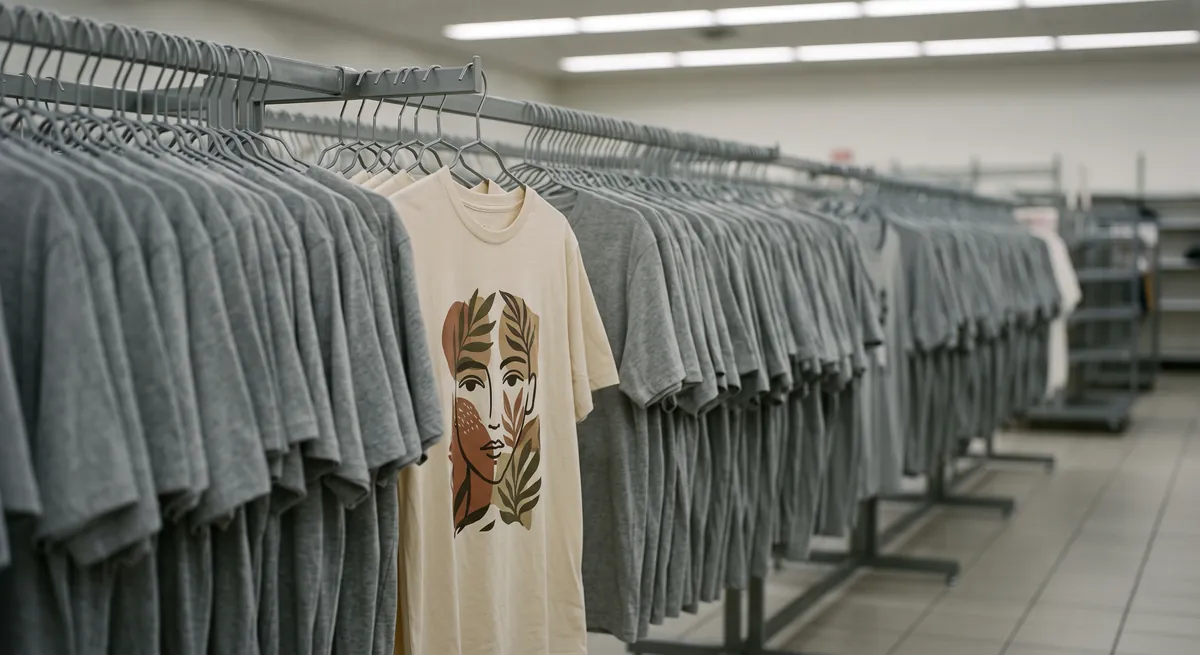
Stand on any busy street and count the shirts. Not the people — the shirts. You'll find the same six or seven, over and over, across an entire city: the sports logo, the band that stopped touring in 2009, the plain heather grey, the slogan that was funny once, the brand name worn as decoration by someone the brand has never met.
This isn't a failure of taste. It's a manufacturing artifact. For a hundred years, making clothes cheaply meant making them identically, and making them identically meant designing for an imaginary average person. We all agreed to dress as that person because the alternative was expensive.
That constraint is dissolving from three directions at once. Here's what actually changes — and, because every essay about the future should include this, what doesn't.
We optimised clothing for a person who doesn't exist
The economics of apparel were built around a bet. A company decides what a lot of people will want, produces it in enormous quantity, and distributes it everywhere. To make the bet safe, the design has to appeal broadly — which means it's a compromise, which means it's a little bit nobody's.
Everything downstream follows. Trends exist because a bet was placed. Sales exist because a bet was wrong. Enormous quantities of clothing are produced that nobody ever chooses, because the only way to be sure the right shirt exists is to make far too many wrong ones. That's not villainy — it's what happens when production must commit before demand shows up.
Mass production doesn't make what people want. It makes what enough people will settle for.
Three constraints broke at once
1. Making a design stopped costing money
Artwork used to require an artist — time, skill, and a fee that only made sense if you printed hundreds of units to amortise it. Generative AI turned original artwork into something you produce by describing it. Whatever else that changes, the design is no longer the expensive part of a garment.
2. Making one stopped being absurd
Screen printing needs a physical screen per colour, so a single shirt costs nearly what fifty cost. Digital garment printing removed the setup entirely — the machine doesn't care whether it's printing one item or a thousand. A production run of one became a normal thing to ask for.
3. Distribution stopped needing a warehouse
Print facilities on multiple continents, connected by an API, means the item is manufactured near the person who ordered it. No central stockpile, no container of guesses crossing an ocean in the hope of being right.
Individually, each is a supply-chain footnote. Together they remove the reason clothing had to be identical in the first place.
What “one of one” actually means
It's used loosely, so: a one-of-one garment isn't a limited edition, and it isn't your initials on a template. It means the design did not exist before you asked for it, and the item did not exist before you ordered it. Quantity produced: one. Quantity that will ever exist: one, unless you order another.
That has a strange emotional effect. A mass-produced shirt is something you own. A one-of-one shirt is something you caused. People treat those categories completely differently — they keep the second one much longer, and they're markedly more likely to tell you the story behind it, whether or not you asked.

The llama has an entire wardrobe of one-of-one items and will explain every single one to you, in order, with context you did not request. This is the correct response to owning something nobody else has.
The scarce thing is no longer skill. It's taste.
When making artwork was hard, being able to make artwork was the differentiator. When anyone can generate a competent image in seconds, competent images stop being worth anything — and knowing which one is good becomes the whole game.
Generation is not creation. A tool that produces four options in eight seconds has moved the work, not removed it: the work is choosing, editing, discarding, and knowing when to stop. That's art direction, and it's real, even though it looks like nothing from the outside.
The good news is that taste is far more evenly distributed than drawing ability. Almost everyone can tell you which of four versions is best. Very few can draw any of them. That asymmetry is why this will be a much bigger deal than it currently looks.
What this doesn't fix
- Volume is not quality. Infinite cheap generation produces infinite cheap output. The floor of what's possible rose; the average will drop, because the average always does when a barrier disappears.
- Models have their own house style. Ask ten thousand people for “cool design” and the same aesthetic comes back with variations. Escaping mass-produced sameness only to arrive at algorithmic sameness would be a funny way to lose. Specificity is the escape route: your dog, your street, your joke — things a model can't average.
- Clothes are still physical objects. Fabric, fit, stitching and how a garment survives twenty washes are unchanged by any of this. A remarkable design on a bad blank is a bad shirt.
- Made-to-order isn't a green halo. Making only what someone asked for avoids producing unsold stock, which is real and worth something. It doesn't make cotton free, shipping weightless, or dye clean. Anyone selling it as guilt-free is selling something.
Where this probably goes
- The catalogue stops being the interface. Browsing a grid of things someone else already made is a workaround for not being able to make your own.
- “Where did you get that?” becomes a worse question. The answer stops being a shop and starts being a sentence you said one evening.
- Small-batch culture explodes. Not just individuals — the group chat, the running club, the wedding, the team of nine. Every micro-community can have its own merch, because the minimum order is finally one.
- Brands become taste, not inventory. If anyone can produce anything, what's left to sell is judgement. That's a healthier thing to compete on than shelf space.
- The wardrobe gets slower and stranger. Fewer disposable purchases; more items with a reason to exist. Nobody throws away the shirt with their late dog painted as a Renaissance monarch.
The quiet version of the future
It won't announce itself. There isn't going to be a day when clothing becomes personal — just a slowly increasing share of what people wear that was made once, for them, because they thought of it and it cost almost nothing to find out what it looked like.
Stand on that same street in ten years and count the shirts again. The interesting number won't be how many are AI-designed. It'll be how many are the only one.
Inka exists to make the one-of-one version normal. Describe an idea in a chat, watch an AI designer take it several ways, steer it until it's actually yours — then have it printed on a tee, hoodie, mug, tote, cap, poster or phone case, checked by a human and made to order. One idea, one item, made for one person.
Start designingKeep reading
Guides · 7 min read
How to design your own shirt when you can't draw
Seven steps from “I have an idea” to a shirt you'd actually wear — including the words that do the heavy lifting, and the ones that quietly ruin the print.
Read it26 August 2026
Explainers · 6 min read
AI print-on-demand, explained without the buzzwords
What POD is, what the AI genuinely does, and the six things that happen to your design after you order — including the boring one that decides how it looks.
Read it26 August 2026