AI print-on-demand, explained without the buzzwords
Explainers · 26 August 2026 · 6 min read
What POD is, what the AI genuinely does, and the six things that happen to your design after you order — including the boring one that decides how it looks.
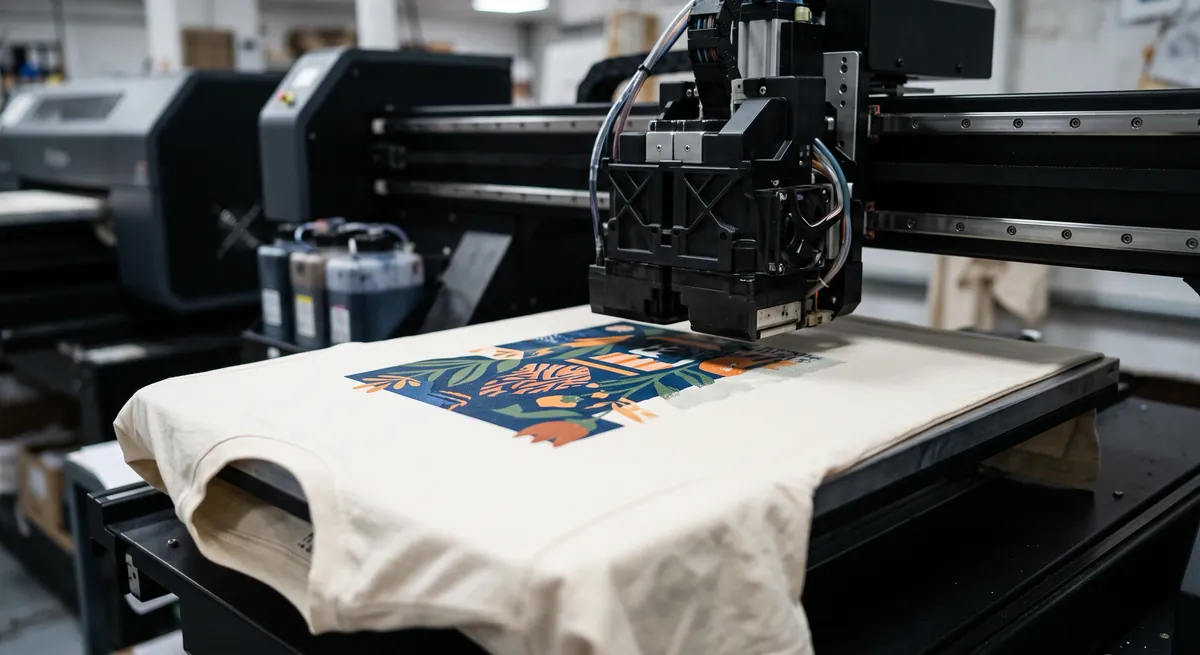
“AI print-on-demand” has been said so often, by so many landing pages, that it's stopped meaning anything. So here it is without the marketing: what print-on-demand actually is, what the AI genuinely does, and what happens to your design in the hours after you order.
Print-on-demand, in one paragraph
Traditional apparel works on guesses. Someone decides a design will sell, orders five hundred units in six sizes, and stores them in a warehouse. Whatever doesn't sell gets discounted, then liquidated, then — often enough — destroyed. The guess is the business model.
Print-on-demand removes the guess. Nothing exists until somebody buys it. Your order reaches a print facility, a blank garment comes off a shelf, your design is printed on it, and it ships. One person, one order, one item. No warehouse of unsold shirts, no minimum order of fifty.
The trade-off is honest: it costs more per unit than printing five hundred at once, and it takes a couple of days because production starts when you order. What you get back is that anything can exist — including a design exactly one person on earth wants.
Mass production asks “how many will sell?” Print-on-demand doesn't have to ask.
So where does the AI come in?
Print-on-demand solved manufacturing years ago. It never solved the actual bottleneck, which is that most people cannot make the artwork. For a decade the answer was: browse someone else's designs, hire a designer, or teach yourself vector software. That's why POD stores drifted into being catalogues of other people's ideas.
Generative AI removes that bottleneck. You describe what you want in ordinary words and get artwork back in seconds — not a template with your name dropped in, but an image made for what you just said. Combine the two and the chain closes: idea → design → physical object, with no professional required at any step.

It is also an excellent way to end up owning eleven shirts about your dog. The llama supports this outcome and considers it a feature.
What happens after you hit order
The interesting part is the middle. A generated image is not a print file, and the gap between them is where quality is won or lost.
- The design is generatedYour words — and your photo, if you gave one — become artwork. Seconds. It's the only step most people ever see.
- It's produced at print resolutionThe image you steered on screen is sharp on a phone and nowhere near enough pixels for a chest-wide print. The print path re-renders it much larger, because enlarging a small image afterwards invents detail that was never there and looks exactly as fake as it sounds.
- The background is removed — last, and carefullyAnything printed on fabric needs a genuinely transparent background, not a white one. Done at full size and after every other image operation: resizing a file that already has soft transparent edges smears leftover colour into them, and that's the halo you see on cheap prints.
- A human looks at itEdges, stray artifacts, text, and whether it holds up at size. The least glamorous step and the one that most affects what arrives.
- It's fitted to the productA tee front is roughly 12 by 16 inches; a mug is a wrap; a phone case is a small portrait rectangle needing much higher pixel density. Same design, genuinely different files.
- It's printed and shipped from nearbyProduction is distributed, so an order in Ohio and an order in Lisbon are printed on different continents and each ships domestically. No ocean crossing, no six-week mystery parcel.
The printing methods, briefly
You don't need to care about this — but it explains why some designs look better than others on the same shirt.
- DTG (direct-to-garment) — ink sprayed into the fabric. Unlimited colours, soft to the touch, slightly muted versus your screen because it soaks into cotton rather than sitting on top. Best for detailed, multi-colour art.
- DTF (direct-to-film) — printed on film and heat-pressed on. Sits on the surface, so colours stay punchier, and it works on fabrics DTG can't handle — like the front of a cap.
- Sublimation — heat turns ink to gas that bonds into a coated surface. Mugs, some polyester. Genuinely permanent, but only on light coated materials.
- Screen printing — the classic. Beautiful and cheap at volume, completely wrong for one-offs: each colour needs its own physical screen made first. Exactly the constraint print-on-demand exists to escape.
The takeaway: designs with strong shapes and real contrast survive all of these. Designs that depend on very fine texture are at the mercy of whichever one is used.
Four things the product pages don't tell you
1. Colours print calmer than screens
Your phone emits light. Ink reflects it. Neon and pure saturated colour will always be more muted in the real world — physics, not a flaw. Designs that lean on contrast rather than intensity arrive looking like the preview.
2. Made-to-order means a production window
Your item is manufactured after you buy it, so there are a few days of printing before shipping begins. Anyone promising same-day dispatch on a custom item is either holding stock — which means it isn't custom — or being optimistic with you.
3. Fully automated is not the flex it sounds like
A pipeline that sends generated art straight to a printer with nobody looking will eventually print an artifact, a misspelling, or a stray edge onto something a person paid for.
4. The blank matters more than the print
A perfect print on a cheap, papery garment is a cheap, papery garment with a nice picture on it. Fabric weight and cut decide whether you reach for it in six months — the least discussed spec in the industry.
Is AI-designed clothing any good?
Where it's genuinely excellent: anything specific and personal. Your dog in a Renaissance oil painting. Your friend group's incomprehensible inside joke as a 1970s tour poster. Your city's skyline as a woodblock print. Things no catalogue can stock — not because they're hard, but because the market for each one is exactly one person.
Where it's weaker: long typography, precise brand-style layouts, and anything needing exact real-world accuracy — a specific car model, an exact team badge. AI is doing an impression of accuracy, and impressions are approximate. Check anything factual with your own eyes.
The output is also only as good as the steering. One prompt taken as-is gives you a decent picture. Four rounds of “bolder, simpler, lose the background” gives you a design. That gap is the entire craft, and it takes about ninety seconds to learn.
Inka is the whole chain in one place: chat your idea, watch an AI designer take it several ways, steer it until it's right, then have it printed on a tee, hoodie, mug, tote, cap, poster or phone case. Human-checked before print, made to order, shipped from the US or Europe — whichever is closer to you.
Start designingKeep reading
Guides · 7 min read
How to design your own shirt when you can't draw
Seven steps from “I have an idea” to a shirt you'd actually wear — including the words that do the heavy lifting, and the ones that quietly ruin the print.
Read it26 August 2026
Ideas · 6 min read
The future of clothing is one of one
Fast fashion optimised for the average person, who doesn't exist. The case for clothes made once, for one person — and what AI genuinely has to do with it.
Read it26 August 2026